
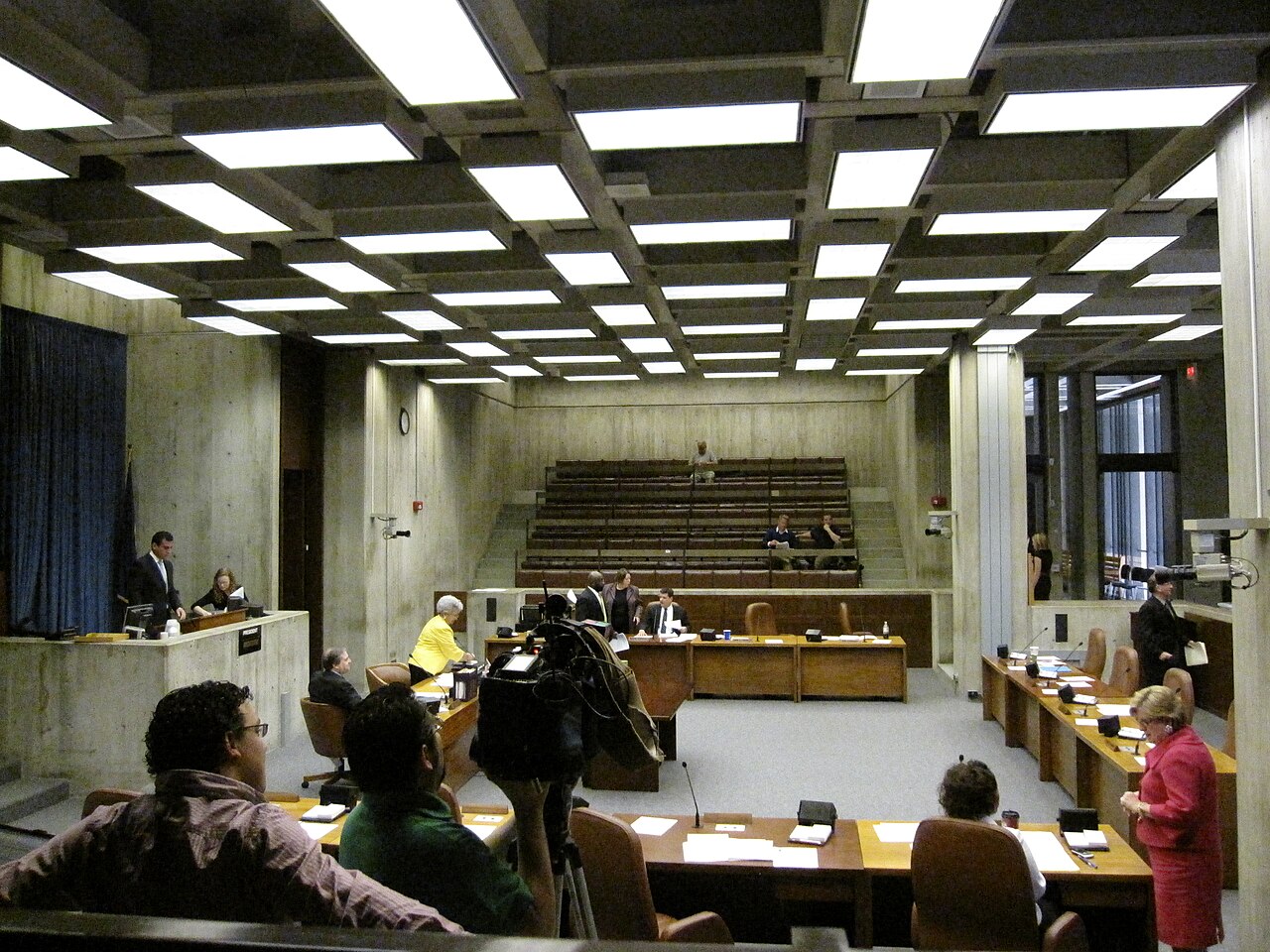
Boston City Council's Committee on Planning, Development, and Transportation noticed a hearing for Monday, Oct. 19, 2026, at 2:00 p.m. on a proposal that would prohibit new data centers in Boston. Docket #1718 is an order for a text amendment to the Boston Zoning Code that would prohibit data centers in all zoning districts. Councilors Miniard Culpepper and Brian J. Worrell sponsor it, according to the city's official hearing page.
The city has confirmed very few facilities that the ban would actually affect. According to Hoodline, city officials have confirmed one data center inside Boston: the Markley Group building at 1 Summer St. in Downtown Crossing. A MassLive analysis of the city's own building-energy filings, also cited by Hoodline, found more.
The records reviewed for this article do not document what happened at the Oct. 19 hearing, and no committee vote appears in them. The questions below cover what the proposal would do, what the city knows about its existing data centers, and where the measure goes from here.
What would Docket #1718 do?
The order asks for a change to the text of the Boston Zoning Code that would prohibit data centers in every zoning district in the city, according to the hearing page. The docket was referred to the Committee on Planning, Development, and Transportation on May 11, 2026.
WBUR reported in September that the ban would include data centers that house equipment for digital data management, artificial intelligence, cryptocurrency and cloud computing. According to WBUR, existing data centers, including the downtown Markley facility, could keep operating under the proposal but would not be permitted to expand. WBUR also reported that the proposal would still allow businesses, telecommunications companies and research labs to run the servers and computing equipment necessary for their operations. Hoodline similarly describes the proposal as protecting smaller server rooms and computing infrastructure used by institutions.
Culpepper said during a council meeting, as quoted by WBUR, that "Boston's density, scarcity of developable land and existing demands on our infrastructure make large-scale data centers incompatible with the direction we should be taking as a city." In an interview with WBUR he said that to his knowledge there are currently no new data center projects proposed in Boston, and that the aim is "just trying to get ahead of data centers that may be in the proposal stage."
How many data centers does Boston have?
The city's official count and the energy-reporting data give different answers.
The facility city officials have confirmed is Markley Group's 1 Summer St. building. Hoodline describes it as a 920,000-square-foot structure built in 1949 and retrofitted in 1998, which houses more than 90 network carriers according to figures Hoodline attributes to Dgtl Infra. WBUR reported that the Downtown Crossing facility, which opened as a data center in 1998, runs on 30 megawatts of electricity. Hoodline quotes Deepjyoti Deka of the MIT Energy Initiative as saying Greater Boston likely has no hyperscale data centers, meaning the massive campuses that can draw more than 100 megawatts, but does have smaller facilities. Hoodline places Markley's capacity, which tops out around 30 megawatts, in the colocation category rather than hyperscale.
A MassLive analysis cited by Hoodline found at least 14 data centers of 10,000 square feet or more in 2025 filings under the city's Building Emissions Reduction and Disclosure Ordinance (BERDO). Seven of them were freestanding Verizon facilities. Hoodline also reported that the Massachusetts Executive Office of Energy and Environmental Affairs has said it does not have a list of existing data centers in the state.
Hoodline reports that Boston has no dedicated permit specific to data centers and instead relies on reporting under BERDO, which covers commercial and non-residential buildings of 20,000 square feet or larger. Hoodline adds that data centers lack a single consistent definition, which it describes as part of the problem in compiling a list. It notes that the EPA's Energy Star program defines a data center as a facility designed and equipped for high-density computing, a definition that excludes less sophisticated setups such as server closets and training rooms.
That matters for how the ban would work. A rule that allows existing facilities to continue but not expand depends on knowing which facilities exist and how large they are today. The sources reviewed here do not say how the proposed amendment would define or inventory existing data centers.
Why is this happening now?
Boston's proposal comes as Massachusetts communities are moving to set their own terms for data center development. WBUR reported that an executive order from Gov. Maura Healey gives Massachusetts cities and towns the final say on whether large data centers are allowed in their communities. Hoodline identifies the order as Executive Order No. 658, signed in September.
Several Massachusetts communities have already acted, according to WBUR. Holyoke became the first city in Massachusetts to ban data centers, in June. Lowell, Westfield and Shutesbury have enacted moratoriums. Boston's proposal is written as a prohibition in the zoning code rather than a temporary pause, which is what a moratorium is.
What do the records say about the hearing?
The committee's hearing notice, dated Oct. 17, 2026, says the hearing would be held before the Committee on Planning, Development, and Transportation, chaired by Councilor Sharon Durkan, in the Iannella Chamber on the fifth floor of Boston City Hall. Public testimony was invited, according to the hearing page. The notice says written comments could be sent to the committee by email, and that the hearing would be recorded and live-streamed.
A committee hearing is not a final decision on a docket. The records reviewed for this article do not include a transcript, minutes or a report of committee action from the Oct. 19 session, and they do not show a vote. The city's recording of the hearing would be the primary record of what councilors, city staff and the public said.
Who decides whether the ban takes effect?
The City Council does not decide alone. WBUR reported that the proposal requires approval by the Boston Zoning Commission before it can take effect.
What Happens Next
Docket #1718 was referred to the Committee on Planning, Development, and Transportation on May 11, 2026, according to the city's hearing page. The sources reviewed for this article do not list a scheduled committee working session, committee report or full-council vote after the Oct. 19 hearing. Under the process WBUR described, the proposal would also need approval from the Boston Zoning Commission before taking effect. DataCenterFeed will report the docket's next on-the-record action when the city posts it.
Sources
- City Council Committee on Planning, Development, and Transportation Hearing on Docket #1718 (boston.gov)
- Committee Hearing Notice, Docket #1718 (boston.gov PDF)
- Boston city councilor pitches a citywide data center ban (WBUR, Sept. 18, 2026)
- Boston Wants to Ban Data Centers but Can't Even Find Most of Them (Hoodline, Oct. 20, 2026)
