
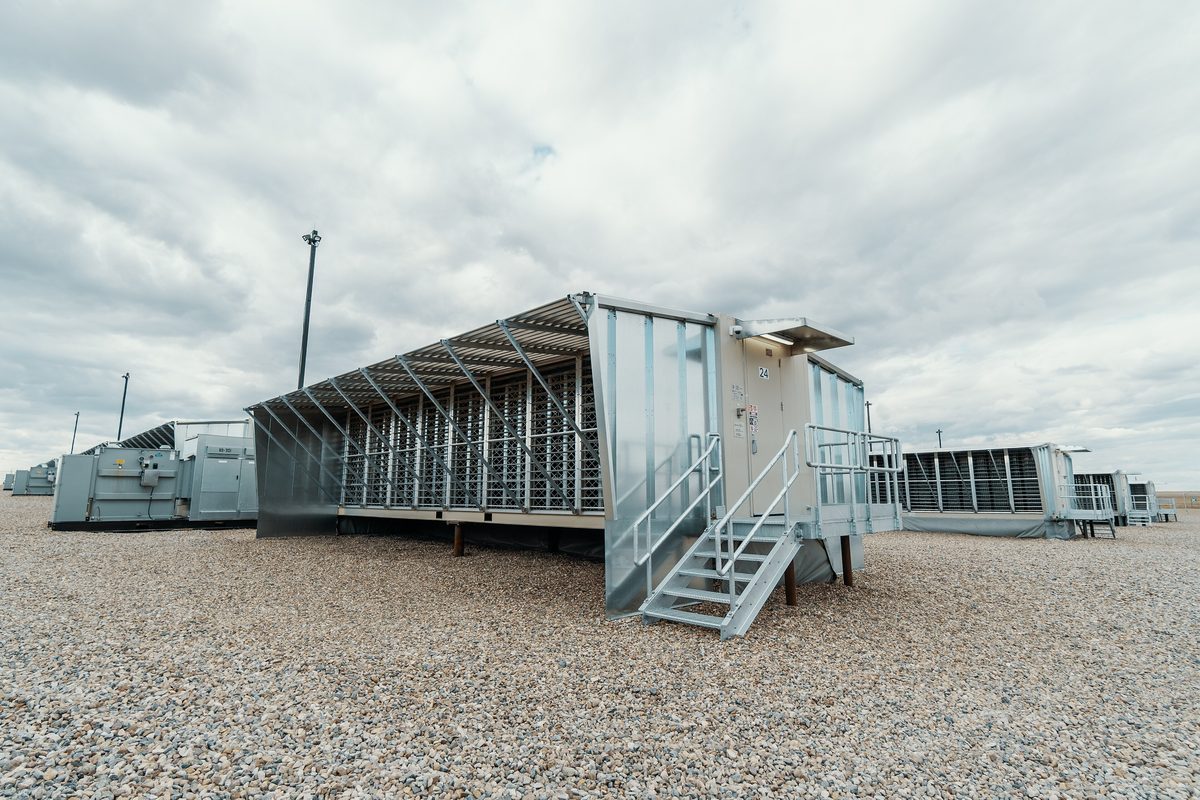
Core Scientific's turn from bitcoin mining to leasing data center capacity is now the main thing its financial statements show. In third-quarter 2026 results filed with the Securities and Exchange Commission on Nov. 5, the company reported colocation revenue of $215.4 million. That compares with $136.7 million in the second quarter and $15.0 million a year earlier. Crypto Briefing described the sequential increase as nearly 60%.
Colocation made up most of the quarter's total revenue of $232.9 million, the company said. Total revenue was $164.2 million in the prior quarter and $81.1 million in the third quarter of 2025.
The quarter also shows what the buildout costs. Core Scientific reported $985.1 million in capital expenditures, up from $797.5 million in the second quarter. It said liquidity, including its debt service reserve account (DSRA), fell to $1,744.2 million at quarter's end from $2,601.1 million three months earlier.
Megawatts Billing
The figure that matters most for a colocation landlord is how much capacity is energized and earning rent. Core Scientific said it was billing on 485 MW at Sept. 30, up from 395 MW at the end of the second quarter. The company said the 485 MW represents "over $700 million in average annualized colocation GAAP revenue."
Finsee, which publishes analyst-style earnings reviews, calculated that the company added 90 MW of new billing power in the quarter. Finsee says the first contract is a 590-MW agreement with CoreWeave, targeted for full delivery in early 2027. It identified the final roughly 100 MW at the Dalton, Georgia, site as the piece to watch. Those are Finsee's characterizations, not statements in the company's release.
Chief Executive Adam Sullivan said in the release that the company is "nearing full delivery under our first colocation agreement while construction under our second is underway across five campuses." Core Scientific also said it is converting its remaining mining facilities to colocation use.
The Second Agreement
The company's release says construction under its second colocation agreement has started at five campuses. Finsee says the company has leased 530 MW under contracts with chipmaker AMD and a credit-backed cloud partner, and treats the second agreement as an AMD buildout. The company release cited here does not give that megawatt figure or name a counterparty, so the 530-MW number and the AMD link come from Finsee's review.
For utilities and local officials near Core Scientific's sites, a buildout at five campuses at once means several sites are moving from mining loads to data center loads at about the same time. Finsee lists a delivery schedule for the second agreement that the company release does not: initial deliveries at Pecos, Texas, and Auburn, Alabama, in the first half of 2027, Dalton, Georgia, and Muskogee, Oklahoma, in the second half of 2027, and Hunt County, Texas, in the first half of 2028, with all 530 MW scheduled by the end of 2028. Finsee does not break the 530 MW down by campus here, and none of the sources report construction headcounts or utility filings.
Profitability and a Non-Cash Gain
Core Scientific reported gross profit of $123.3 million and adjusted EBITDA of $133.6 million. It put its adjusted EBITDA margin at 57%, compared with 25% in the prior quarter. Finsee reported operating income of $72.4 million, compared with an operating loss of $78.5 million in the second quarter.
Headline net income was $1.178 billion. The company attributed it mainly to a non-cash change in the fair value of warrants, and Crypto Briefing also attributed its rounded $1.2 billion figure to a non-cash warrant fair-value gain. That accounting gain comes from revaluing financial instruments on the balance sheet, not from colocation operations, so readers comparing quarters will likely find gross profit, adjusted EBITDA and operating income more useful.
Capital Spending Versus Liquidity
The gap between spending and cash is the main open question in the quarter. Capex reached $985.1 million, following $797.5 million in the second quarter, according to the company. Over the same three months, liquidity and DSRA fell from $2,601.1 million to $1,744.2 million.
Finsee wrote that third-quarter capex drained nearly half of the company's unrestricted cash. It said the open question is whether existing liquidity and incoming cash rent can fund the 530-MW buildout without new debt or shareholder dilution. That is an analyst framing. The company's release, as summarized here, does not announce new financing tied to the second agreement.
The basic economics of the shift look like this: capital spent now on power, cooling and building conversions is paid back over time through colocation rent, which the company now puts at more than $700 million a year on an average annualized basis for its 485 billing megawatts. How fast the remaining capacity under the first agreement and the five-campus second phase starts billing will determine how quickly that revenue line catches up with spending.
The Numbers, Side by Side
- Colocation revenue: $215.4 million in Q3, vs. $136.7 million in Q2 and $15.0 million in Q3 2025 (company).
- Total revenue: $232.9 million, vs. $164.2 million in Q2 and $81.1 million a year earlier (company).
- Billing capacity: 485 MW at Sept. 30, vs. 395 MW at Q2 (company).
- Adjusted EBITDA: $133.6 million, 57% margin, vs. a 25% margin in Q2 (company).
- Capex: $985.1 million, vs. $797.5 million in Q2 (company).
- Liquidity and DSRA: $1,744.2 million, vs. $2,601.1 million at Q2 (company).
- Second agreement: construction underway across five campuses (company); 530 MW leased, AMD-linked (Finsee).
What Happens Next
Core Scientific held its earnings call on Nov. 5 at 8:30 a.m. ET. The next milestone named in the sources is finishing the first colocation agreement. The company says it is "nearing full delivery." Finsee puts full delivery of the 590-MW CoreWeave contract in early 2027, with the final roughly 100 MW at Dalton, Georgia, as the remaining piece. Construction under the second agreement is underway at five campuses, according to the company. Finsee's per-campus delivery windows run from the first half of 2027 through 2028, and the company release gives no dates.
