
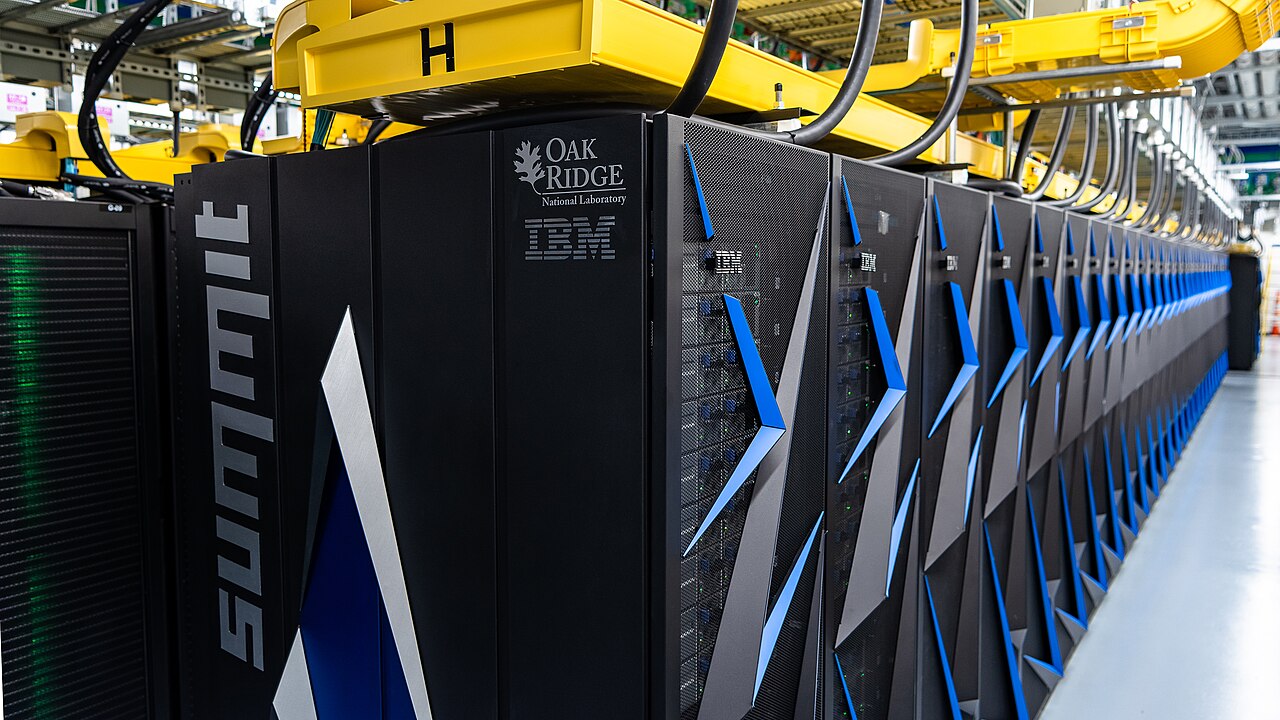
Oak Ridge National Laboratory's newest machine is not another leadership-class supercomputer built mainly for double-precision simulation. It is a dedicated AI cluster, and part of its capacity is sold to paying customers. On Nov. 16, 2026, AMD, Hewlett Packard Enterprise and ORNL announced that Lux, a system built around AMD Instinct MI355X GPUs, is open to scientific users. The same day it debuted on the TOP500 list at No. 14.
The ranking is the headline number, but the more telling details are on the lab's own Lux system page. It lays out how the machine is split between a federal research program and paying customers, how access is sold, and what security controls it runs under. Taken together, those details describe a shared, multi-tenant AI system at a national lab, which is a different design target from the big simulation machines the lab is known for.
Two Kinds of Numbers
Lux comes with two very different sets of performance figures, and readers should keep them apart.
The measured figure is 220.79 petaflops. HPE's SC26 announcement, which was distributed via Business Wire and carried on Finviz, gave that number and said Lux debuted as the world's 14th-fastest system on the TOP500. The AMD release also gives the No. 14 ranking.
The second set is quoted peak capability at lower precision. The OLCF spec page lists 40 exaflops of FP4 for inference, 20 exaflops of FP8 for training and 317 petaflops of FP64 for modeling and simulation. These are rated peaks for the numeric formats AI workloads use. They are not benchmark results, and the FP4 and FP8 figures cannot be compared directly with the 220.79-petaflop TOP500 score, which is a different kind of measurement.
What Is Inside the Machine
Per the OLCF page, Lux has more than 4,000 AMD Instinct MI355X GPUs spread across more than 500 nodes. Each GPU carries 288 GB of high-bandwidth memory, and the lab gives total HBM capacity as 1.1 petabytes. AMD's release says the system pairs AMD EPYC processors with the Instinct GPUs, uses AMD Pensando networking and runs on AMD's ROCm software stack. HPE built it.
The interconnect is Ultra Ethernet, with a 400G network interface card for each GPU, according to the lab. HPE said Lux is the first deployment of HPE Networking solutions at a DOE national laboratory, and described the system as co-designed and co-constructed with AMD.
On the software side, the OLCF page says Lux supports both Slurm, the batch scheduler common in HPC centers, and Kubernetes, the container orchestration layer common in cloud deployments. HPE describes Lux as a flexible, multi-tenant platform that gives U.S. researchers cloud-like access to resources for AI training and inferencing.
Lux also connects to existing ORNL infrastructure. The lab says allocations include access to Orion, OLCF's Lustre file system, which it puts at more than 600 petabytes. The system runs under DOE Moderate security controls, which the OLCF page says are the same level as those on Frontier.
Half for Genesis, Half for Sale
The allocation model is the most unusual part of the system. According to the OLCF page, Lux provides 3.5 million node-hours a year. Half of those hours are dedicated to DOE's Genesis Mission. The other half are available for paid, proprietary use at the DOE User Facility rate. HPE's announcement gives the same half-and-half split.
The lab sets clear terms for the paid half:
- Projects can run from six months to five years.
- The minimum commitment is 175,000 node-hours per six-month period.
- Full-system jobs may be limited to fewer than 4,000 GPUs, depending on nodes dedicated to persistent services.
The lab gives an example of what the minimum buys: 400-node (3,200-GPU) jobs for eighteen days spread over six months, or roughly 40 nodes in continuous use for six months. Partners buy node-hours and can consume them at any scale, from single-node jobs to full-system jobs. The OLCF page also says AMD will use part of the reserved time for development and testing and will make a portion available to new partners. AMD's release points prospective users to OLCF to discuss access.
The Genesis Mission Workload
AMD describes Lux as the first dedicated U.S. "AI Factory" for DOE's Genesis Mission, and HPE calls it the first dedicated AI system designed to support Genesis to come online. AMD's release names three kinds of Genesis projects allocated to run on it:
- AI-assisted fusion power plant design
- An AI-based foundation model factory for materials development and advanced manufacturing
- Earth system prediction to forecast water availability, streamflow and river temperature in the Tennessee Valley Authority region
The announcements include statements from AMD's Thomas Zacharia, ORNL's Georgia Tourassi and HPE's Trish Damkroger. HPE also said it made an in-kind investment of $37 million to advance the Genesis program and support research projects. The companies have not published capital cost, power draw or facility footprint figures for Lux in the materials reviewed here, and DataCenterFeed is not reporting any.
Why It Matters for AI Infrastructure
For anyone tracking how AI compute is built and sold, Lux uses several design choices familiar from commercial AI clusters in a government lab setting. These include Ethernet-based scale-out networking, one 400G NIC per accelerator, Kubernetes alongside a traditional scheduler, and a tenancy model that sells blocks of node-hours on fixed terms. It also sits inside the lab's existing DOE Moderate security controls and its Orion file system, so allocations include both without a separate build-out by the customer.
It is also a large deployment of AMD's MI355X and its surrounding stack, from EPYC host processors to Pensando networking and ROCm software, and one with a public TOP500 result at 220.79 petaflops.
What Happens Next
According to the AMD release and the OLCF page, Lux is open now. Researchers and organizations seeking time are directed to the Oak Ridge Leadership Computing Facility. Paid projects run six months to five years, with a minimum of 175,000 node-hours per six-month commitment.
AMD's release says the upcoming Discovery supercomputer will extend this commitment with deeper integration of AI and high-performance computing, and HPE describes it as the forthcoming successor to Frontier. Neither the AMD release nor the HPE announcement gives a delivery date for Discovery.
